
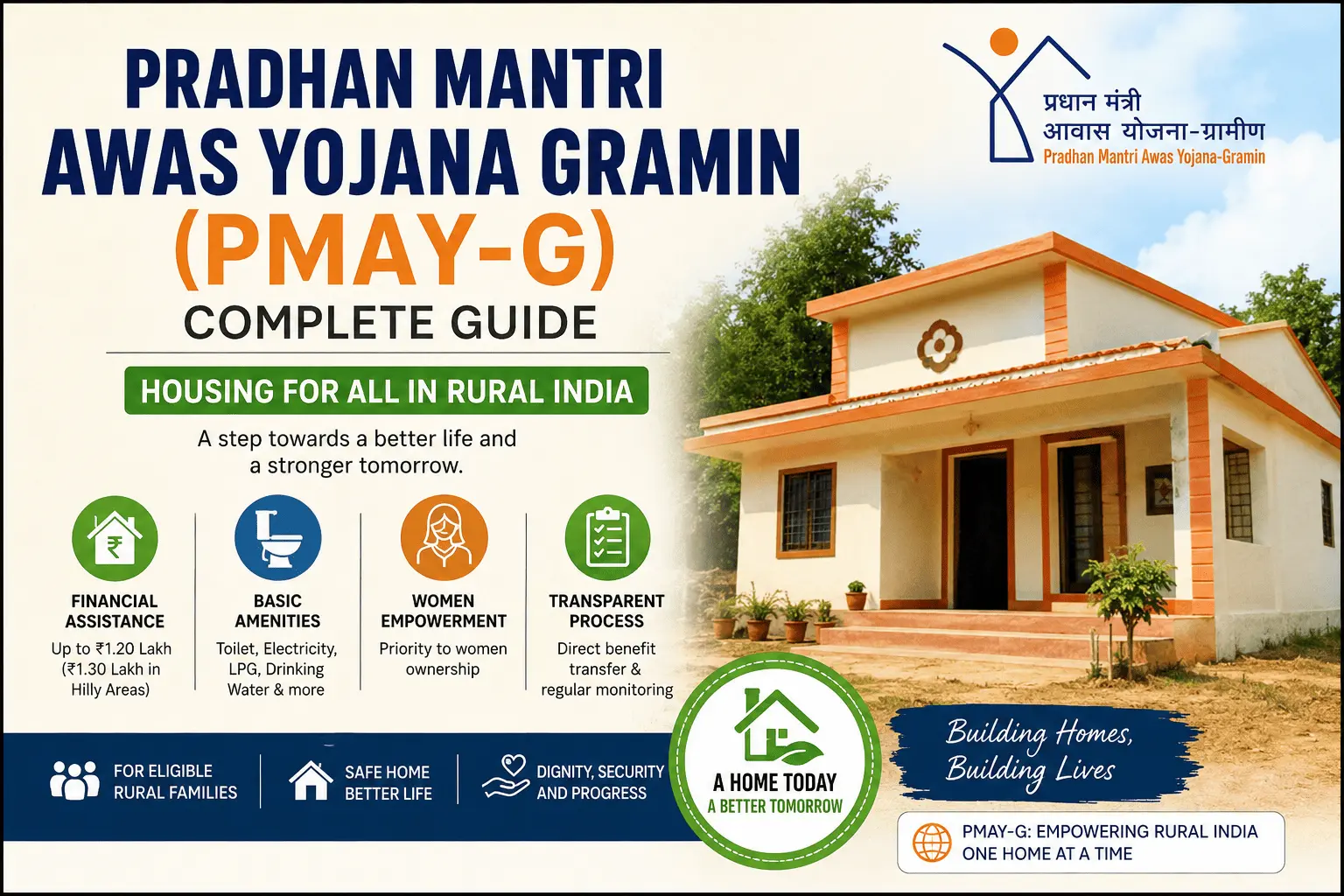

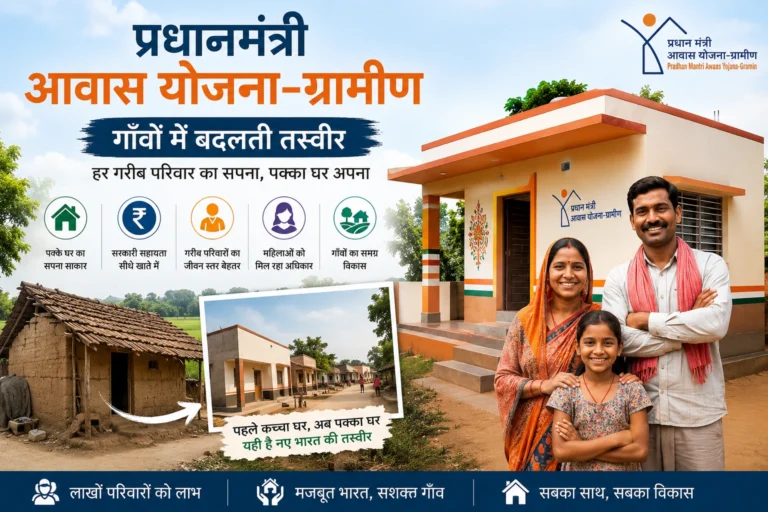
Hello friends, welcome! In this blog post, we’re going to talk about a scheme that has changed millions of lives in rural India — Pradhan Mantri Awas Yojana Gramin (PMAY-G). Have you ever dreamed of building your own permanent home — a proper pucca house with a strong roof and walls that won’t leak during the rains? For countless families living in rural parts of India, this dream has come true because of PMAY-G.
If you or your family live in a kutcha house (a temporary house made of mud, bamboo, or thatch) or if you don’t have a house of your own at all, then this article is for you. I’m going to explain everything in simple, everyday English — eligibility, benefits, how to apply, and I’ll even walk you through a step‑by‑step practice example so you know exactly what to do. Plus, you’ll read some inspiring real‑life stories of people who have already been helped by this wonderful government program.
Let’s dive in.
What Exactly is PMAY-Gramin?
In very simple words, PMAY-G is a housing scheme launched by the Government of India in April 2016 (it restructured the earlier Indira Awaas Yojana). Its goal is beautifully simple: “Housing for All” in rural India.
The scheme provides financial assistance to eligible rural families so they can build a pucca house — a permanent, strong house with basic amenities like a kitchen, toilet, drinking water connection, and electricity. Think of it as the government giving you money (in installments) to construct your own home. You are the owner; you build it, you live in it, and it belongs to your family.
Key Features You Should Know About
Let me list the most important features of PMAY-G in a simple way:
| Feature | What It Means |
|---|---|
| Pucca House | The house you build must be permanent. Minimum size: 25 square meters (about 270 sq. ft.) with a dedicated area for hygienic cooking. |
| House Size | Minimum 25 sq.m (larger than the earlier 20 sq.m). This is enough for a small family’s needs. |
| Financial Help | You get up to ₹1.20 lakh if you live in a plain area, and up to ₹1.30 lakh if you live in a hilly or difficult area (like the North‑Eastern states or Himalayan regions). |
| Direct Payment | The money goes straight into your bank account (or post office account) using Direct Benefit Transfer (DBT). No middlemen, no delays — it’s transparent. |
| Employment Support | The scheme also gives you 90 to 95 person‑days of unskilled labour under MGNREGA. That means you can earn wages while helping to build your own house. |
| Toilet Assistance | Through convergence with Swachh Bharat Mission (Gramin), you get ₹12,000 for building a toilet in your new home. |
| Focus on Women | The house is usually registered in the name of the female head of the household (or jointly with her husband). This empowers women and gives them ownership. |
| Technology | Everything is tracked using geo‑tagged photos, the AwaasSoft portal, and even AI‑based fraud detection. So it’s honest and transparent. |
As of recent data, the scheme has been extended until FY 2028–29, with a cumulative target of building 4.95 crore houses. Imagine that — nearly 5 crore homes across rural India! Already, more than 2.82 crore houses have been completed.
How to Check Your Eligibility for Pradhan Mantri Awas Yojana Gramin
Before you apply, you must check if you are eligible. The government uses data from the Socio-Economic and Caste Census (SECC) of 2011.
- Step 1: Go to Pradhan Mantri Awas Yojana Gramin
- Step 2: Select your area ( Rural & Urban)
- Step 3: Select this options Own Pucca House, Current House Condition, Category, Below Poverty Line
- Step 4: Check Eligible
Who Can Apply? (Eligibility Conditions)
Not everyone living in a rural area is automatically eligible. The government uses data from the Socio‑Economic and Caste Census (SECC) 2011 to identify the neediest families. That list is then verified by the Gram Sabha (village council).
Here are the basic eligibility conditions:
- You must not own a pucca house anywhere in India — not you, nor any family member.
- Your household must be living in a kutcha house or a dilapidated semi‑pucca house currently.
- You must belong to a deprived category as per SECC 2011 data — for example: landless labourers, widows, single women, disabled persons, Scheduled Castes (SC), Scheduled Tribes (ST), families with no literate adult above 25 years, etc.
Who is not eligible? Families that own a motorcycle, a car, a tractor, or large agricultural equipment; those with a Kisan Credit Card (KCC) limit of ₹50,000 or more; government employees; income tax payers; families with refrigerators, landline phones, or large landholdings.
In simple terms: this scheme is for the truly needy and deprived rural families.
Documents You Will Need
Before you apply, make sure you have these documents ready:
- Aadhaar card (mandatory) — linked to your bank account for DBT.
- Bank account details (bank name, branch, account number, IFSC code).
- MGNREGA job card (if you have one) — this speeds up the convergence benefits.
- Swachh Bharat Mission number (if you have a toilet or have started one).
- Affidavit stating that you and your family do not own a pucca house anywhere domestically.
- BPL card or SECC certificate (if available).
- Land ownership documents (if you already have a plot; if not, the Gram Panchayat may help allocate land).
If you are illiterate, you can still apply. All you need is to provide a consent letter with your thumbprint instead of a signature.
Step‑by‑Step Application Process (Online & Offline)
The government has made applying very simple. You can choose whichever way suits you best.
Online Application (Via PMAY-G Portal)
- Visit the official website: https://pmayg.nic.in.
- On the homepage, go to the login/registration section.
- Enter your Aadhaar number to check if you are already in the beneficiary list.
- If your name is there, you will see options to fill in personal details (name, gender, mobile number, family composition).
- Upload the Aadhaar consent form to permit use of your Aadhaar for verification.
- Fill in your bank account details.
- Provide convergence details — MGNREGA job card number and Swachh Bharat Mission number (if applicable).
- Review everything, tick the self‑declaration, and submit. You will receive a reference number for tracking.
- The local Gram Panchayat or block office will verify your application. Once approved, your name is added to the Permanent Wait List, and you will receive the first installment in your bank account.
Offline / In‑Person Application
If you are not comfortable with the internet, you can:
- Visit your Gram Panchayat office or the nearest Common Service Centre (CSC) in your village.
- Ask for the PMAY-G application form. A village official or CSC operator will help you fill it out (using your Aadhaar, bank, and job card details).
- If needed, a third party can fill the form for you, but they must have your written, thumb‑impressed consent to use your Aadhaar.
- The form is then submitted to the Gram Panchayat, which forwards it to the block‑level office for verification.
Using the AwaasPlus App
You can also download the AwaasPlus mobile app from the Google Play Store. The app allows you to do a self‑survey, check your eligibility, and even track the progress of your house construction using geo‑tagging.
Practice Example: Applying for PMAY-G (Step‑by‑Step)
Let me walk you through an imaginary but realistic example so you can truly see how it works.
Meet Sita Ben, a 40‑year‑old widow living in a small village in Gujarat. She has three children and lives in a crumbling mud‑and‑thatch kutcha house. Every monsoon, water leaks through the roof, making life miserable. She has a small plot of land (given by her late husband) and a bank account. She has applied for a job card under MGNREGA.
Step 1 — Checking Eligibility
Sita’s village Sarpanch tells her that all families living in kutcha houses have been surveyed under the Awaas+ 2024 survey. Her family is listed as “deprived” in the SECC data because she is a widow and has no literate adult.
Step 2 — Gathering Documents
She collects:
- Her Aadhaar card (attested copy)
- Bank passbook (showing her account number and IFSC)
- Affidavit stating no pucca house owned
- Her MGNREGA job card
- Land patta (ownership document)
Step 3 — Visiting the Common Service Centre (CSC)
Sita goes to her village CSC. The operator opens pmayg.nic.in, enters her Aadhaar number, and the system shows she is already in the beneficiary list! They fill out the remaining details together: her name, address, bank details, job card number, etc. They scan and upload her documents.
Step 4 — Verification
Within two weeks, the Gram Panchayat secretary and a block‑level official visit her house to physically verify that she indeed lives in a kutcha house and that her documents are correct.
Step 5 — Sanction & First Installment
Two months later, Sita receives an SMS: “₹40,000 direct benefit transferred to your bank account” — this is the first installment of PMAY-G. She also learns she will get four more installments for the rest of the ₹1.20 lakh, plus 90 days of MGNREGA wages (approximately ₹25,920) for labour and ₹12,000 for a toilet.
Step 6 — Construction
Sita hires a local mason trained by the government. She uses the money to buy cement, bricks, sand, and iron. Over the next six months, with her own labour and the mason’s help, her beautiful, solid pucca house takes shape. The final two installments arrive as milestones are completed (foundation, roof casting, finishing). She also builds a toilet and gets a electricity connection.
Step 7 — Happy Home
Now, Sita and her children sleep peacefully during rains. She feels proud to own a home registered in her name. Her neighbours admire her house and many are now inspired to apply for PMAY-G themselves.
That is how simple — and life‑changing — this scheme is!
How to Check the Beneficiary List and Status
Once you have applied, you will naturally want to know if your name is in the list and what the status of your application is.
Method 1 — Official Website:
- Visit https://pmayg.nic.in.
- Click on “Stakeholders” → “IAY/PMAYG Beneficiary” or “Search Beneficiary” .
- Choose “Advanced Search (ASF)” .
- Enter your State → District → Block → Village.
- Click submit. The beneficiary list for your village will appear. Find your name (search by your name or job card number).
- You can see details like: Sanctioned amount, installments released, geo‑tagged photos of construction progress, etc.
Method 2 Using the UMANG App:
Download the UMANG app from the app store. Search for “Pradhan Mantri Awas Yojana” . Under that, select “Installment Details” , enter your registration number, and your installment status will be displayed.
If your name does not appear in the list, don’t be disheartened. The government regularly updates the Permanent Wait List and conducts new Awaas surveys. You can approach your Gram Panchayat to see if you can be included in the next cycle.
Beyond the House: Extra Convergence Benefits
One of the best things about PMAY-G is that it does not stop at giving you money for a house. The government integrates other schemes so that your new house becomes a complete home with essential utilities.
Here are some of the convergence benefits you automatically become eligible for (once you are a PMAY-G beneficiary):
| Converged Scheme | Benefit Provided |
|---|---|
| MGNREGA | 90‑95 person‑days of unskilled labour, worth approx. ₹25,920 (in many states). |
| Swachh Bharat Mission (Gramin) | ₹12,000 for construction of a toilet in your new house. |
| Pradhan Mantri Ujjwala Yojana | Free LPG connection for your kitchen. |
| Jal Jeevan Mission | Tap water connection to your house (piped drinking water). |
| PM Surya Ghar Yojana / Renewable Energy | Solar lighting / electricity connection. |
So, you aren’t just building four walls. You are getting a kitchen, toilet, water, gas, and light — all the essentials for a dignified life.
Real‑Life Success Stories:- How PMAY‑G Changed Lives
Let me share a few real stories of ordinary people whose lives were transformed by this scheme. I hope these will inspire you.
Story 1: Nondo from Mizoram
Nondo is a daily wage labourer in a small village in Mizoram. He worked hard to feed his wife and five children, but their kutcha house had a leaky roof and crumbling walls. During monsoons, water would pour in. The family was constantly sick and anxious.
In 2017, Nondo’s name appeared on the beneficiary list. He received financial help and built a sturdy pucca house. “The new house brought a profound sense of security,” he says. “No longer did we worry about rainwater flooding our home or chilly winds making our children sick.”
This story was reported by the Press Information Bureau (PIB) in 2024.
Story 2: Sirkheda Village, Madhya Pradesh
In Sirkheda village, Madhya Pradesh, Vikram Bhil lived in a kutcha house that made life miserable every rainy season. “Earlier, we used to face a lot of problems. There was so much trouble during the rains,” he says. Then he got a house under PMAY‑G. “We got the money and built a permanent house. We are very grateful to PM Modi.”
Usha Meghwal, another villager, adds, “My husband had a kutcha house. Now we have a pucca house. Earlier the roof would leak, the house would get sealed. We want to thank Modi ji.”
The woman Sarpanch, Shyamu Bai, confirms: “So far, 37 houses have been built and more are coming. Their standard of living has improved.”
Story 3: Mamta from the Tharu Tribe, Uttar Pradesh
Mamta belongs to the Tharu tribe living in remote Barbata village near the Nepal border. The family lived in a flimsy mud‑roofed house. “We never thought anyone would care about us. I was shelterless. Today, I live in my own house with my family, without any worries,” she says. “Now, we have a proper house. The roof doesn’t leak in the rain anymore. We live peacefully, and I no longer worry for my children’s safety.”
Story 4: Chhotu Mandvi – From Naxalite to Homeowner, Chhattisgarh
In Naxal‑affected Dantewada, Chhotu Mandvi had been a Naxalite for five years before surrendering in 2020. As part of a special rehabilitation campaign, the district administration gave him a pucca house under PMAY‑G. “The government is providing housing, electricity, water, everything. We thank them for this,” he told ANI.
Story 5: Assam’s Dibrugarh District
In Assam, Bhola Das and others have moved from kutcha to pucca houses. One beneficiary recalled: “Water would leak into our homes, making it impossible to sleep. The children suffered greatly. Now, having a permanent home, we live a safe and comfortable life. This scheme has given us the opportunity to live with dignity.”
Challenges and Ground Realities — A Balanced View
While PMAY‑G is an amazing scheme, it is not without challenges. I think it is fair to mention them so you know what to watch out for.
- Completion Rates Vary by State : As of 2025, national average completion was around 73.5%. However, Karnataka had a mere 30% completion rate (only 1.58 lakh completed out of 5.25 lakh sanctioned) owing to low unit cost and land availability issues. Maharashtra had only 38% of sanctioned houses completed despite many being sanctioned. On the other hand, Jammu & Kashmir achieved 95% completion.
- Insufficient Unit Cost : Many beneficiaries in states like Karnataka argue that ₹1.20 lakh is not enough to build a good pucca house in today’s high‑inflation market (cost of bricks, cement, steel and labour have all gone up). The government’s response is that convergence with MGNREGA (wage labour) and other schemes supplements the amount.
- Aadhaar Authentication Delays : In Maharashtra, release of installments was delayed because of Aadhaar‑bank account mismatches with the PFMS system.
- Land for the Landless : If you are landless, the Gram Panchayat must first allocate you a plot. In many states, this process can be slow.
Despite these challenges, the scheme has brought more good than harm. Over 2.82 crore families now own a pucca home, a toilet, and basic amenities, all because of PMAY‑G. That is monumental progress.
Frequently Asked Questions (FAQs)
Let me answer some common questions readers often ask.
- Is there an income limit for PMAY‑G?
No explicit income certificate is required. Eligibility is based on SECC 2011 deprivation criteria (poverty, lack of pucca house, landlessness, etc.). - Can I apply for PMAY‑G if I already have a small land?
Yes! If you have land but no pucca house, you are eligible. If you are landless, the government will help allocate land. - Will the assistance come as a lump sum?
No. It comes in three (sometimes four) installments directly to your bank account. The first installment is typically ₹40,000, followed by later payments as construction milestones are completed. - How long does it take to get a house?
From nomination to completion, it can take 6 to 18 months, depending on local administration speed, release of funds, availability of land, and your own pace of construction. - Can I build the house with my own hands?
Absolutely! You can be your own contractor. The scheme encourages use of local materials and locally trained masons. In fact, you can earn MGNREGA wages for the labour you put in. - What if I am illiterate?
No problem. You can provide a thumb‑impressed consent letter instead of a signature. Village officials or CSC operators will help you fill the form. The application process is designed to be inclusive. - Is PMAY‑G still open for new applications?
Yes. The scheme has been extended till 2028–29. New surveys (Awaas+) are being conducted to add more eligible households. So if your name is not yet in the list, don’t lose hope — you may be added in the next cycle.
Handy Tips for a Smooth PMAY‑G Experience
- Keep your Aadhaar and bank account linked — Make sure your Aadhaar number is seeded with your bank account. Otherwise, DBT transfers may fail.
- Always keep copies of your application and reference number — You will need them to track your status online.
- Cooperate with Gram Panchayat officials — They are the ones who will verify your house and release installments. Stay in touch and respond promptly to any verification visits.
- Build as per the approved design — Use the government‑approved design format (minimum 25 sq.m, with hygienic cooking area). Don’t deviate from the plan, or later installments may be blocked.
- Document your progress — Take photos of each stage (foundation, walls, roof, finishing). These are needed for geo‑tagging and to prove that money is being used properly.
- Use the convergence benefits — Apply for your MGNREGA job card, toilet under Swachh Bharat, LPG under Ujjwala, and tap water under Jal Jeevan alongside your house construction. They cost nothing extra and vastly improve your quality of life.
How the Government Ensures Transparency (So You Don’t Get Cheated)
One of the biggest fears in any government scheme is corruption or leakage. PMAY‑G has built‑in checks:
- Direct Benefit Transfer — Money goes straight to your bank account, not through any middleman.
- Geo‑tagging — Every house construction is photographed and geo‑tagged at each stage (foundation, lintel, roof, completion) using a mobile app. This prevents someone from claiming a fake house.
- AwaasSoft Portal — All data is online, available for public view. You, your neighbours, and even the state officials can see exactly how many houses have been sanctioned, how many completed, and where funds have gone.
- AI and ML Based Fraud Detection — The system flags anomalies where pictures or data seem suspicious.
- Gram Sabha Verification — Every nomination must be ratified by the village council in public meetings, so fake beneficiaries cannot be added secretly.
These measures have made PMAY‑G one of the most transparent and efficient rural development schemes in India.
Conclusion: A Home of Security, Dignity, and Hope
The Pradhan Mantri Awas Yojana Gramin is not just a housing scheme. It is a promise of safety, a symbol of dignity, and a stepping stone to a better future. A pucca house protects your family from rain, cold, and heat. It gives your children a proper place to study. It gives you a permanent identity and a sense of pride. And when the house is registered in the name of the woman of the family, it empowers her as never before.
If you or someone you know lives in a kutcha house or has no house at all, I encourage you to approach your Gram Panchayat today. Ask them about the Awaas+ survey and whether your family qualifies. With a little effort, you, too, can become a homeowner under PMAY‑G.
The dream of a pucca house is now within reach for every deserving rural family. More than 2.82 crore families have already made that dream come true. The scheme is continuing until 2029. There is plenty of time, but don’t delay — the sooner you apply, the sooner you will have a roof that doesn’t leak.
Please help me
Yamunanagar Jagadhri landora gaon toll plaza Mustafabad Dak Khana